🌿 terpenes 101
Terpenes Are More Than Just Smell
THC and CBD aren't the whole story.
When we talk about cannabis, the conversation tends to revolve around THC and CBD, but there is an entire world of plant chemistry happening beyond cannabinoids. Terpenes are aromatic compounds found throughout the plant world, particularly cannabis, and they play an important role in the unique aromas, flavors, and potentially biological effects we associate with different plants and cannabis products. If you've ever wondered why two products with similar THC and CBD percentages can feel completely different, the terpene profile may be part of the story. For pregnant patients especially, learning about terpenes can be another piece of the puzzle when navigating cannabis conversations, product information, efficacy, and the often confusing world of cannabis research. However, this information isn't exclusive to pregnancy. Whether you're pregnant, breastfeeding, a longtime cannabis consumer, a curious stoner, or simply someone who wants to understand the plant beyond “how much THC is in it,” this page is here to help you understand what terpenes are, what researchers are actually studying, what we know, what we don't know, and how to become a more informed reader of cannabis chemistry.
🧬 terpenes + cannabinoids: the “entourage effect”
One of the most talked about ideas in cannabis science is the “entourage effect,” the theory that cannabinoids, terpenes, and other naturally occurring compounds in the plant may interact with one another and influence the overall effects of a cannabis product. In other words, the plant may be more complicated than simply looking at a THC or CBD percentage and calling it a day. Researchers have explored whether certain terpenes can influence cannabinoid activity, affect the way cannabinoids interact with biological systems, or contribute their own effects to the overall experience. This is one reason two products with similar cannabinoid percentages can feel very different to different people. But here's where we need to pump the brakes on some of the marketing… The entourage effect is still an area of active research, and we don't yet have enough human clinical evidence to say that a particular terpene will reliably produce, or cancel out, a particular cannabinoid effect. Some findings are based on laboratory or animal research, while others are still theoretical. So when you see claims like “this terpene counteracts THC anxiety” or “that terpene makes THC more sedating,” think of those as hypotheses worth investigating rather than guarantees. The goal of terpene education isn't to memorize a list of promises; it's to understand the chemistry well enough to recognize what the research actually tells us, what it doesn't, and why the whole plant profile can be worth paying attention to.
what exactly is a terpene?
As we previously stated, terpenes are naturally occurring aromatic compounds produced by plants, and cannabis is just one of many plants that produce them. They’re responsible for much of the smell and flavor we experience in the plant world, from the citrusy aroma of an orange peel to the unmistakable scent of pine needles and the floral fragrance of lavender. In cannabis, terpenes contribute to the unique aroma and flavor profiles of different cultivars, but their role may extend beyond simply making a plant smell good. Researchers are studying how individual terpenes interact with biological systems, including their potential effects on inflammation, pain, mood, stress, and other physiological processes. This is where terpene education gets really interesting! A terpene isn't a guarantee of a particular effect, and “this terpene = this feeling” is an oversimplification, but understanding which terpenes are present can give us another piece of the puzzle when we're looking at the plant as a whole. And because terpenes aren't exclusive to cannabis, learning about them here can also help you understand the chemistry behind many of the other plants, herbs, fruits, and foods you already encounter every day.
-
Smells like: earthy, herbal, musky, fruity
Commonly associated with:
relaxation
sedating effects
anti-inflammatory activity
analgesic activity
Where else you'll find it:
mangoes, lemongrass, basil, hops, etc.What the research actually says:
There is preclinical evidence for biological activity, but translating that into a predictable effect from cannabis in humans is another matter.Pregnancy Lens: Myrcene is particularly interesting when we're talking about rest, discomfort, and inflammation, because preclinical research has investigated myrcene for analgesic, anti-inflammatory, and sedative effects. Those properties could make myrcene-rich profiles scientifically interesting to someone dealing with pregnancy-related aches, difficulty settling down, or sleep disruption. However, these findings come primarily from preclinical research, so we can't assume that the amount of myrcene in a cannabis product will produce a predictable sedating or pain-relieving effect in a pregnant patient.
-
Smells like: lemon, orange, citrus peel
Commonly studied for:
mood-related effects
stress/anxiety pathways
antioxidant activity
anti-inflammatory activity
analgesic activity
Where else you'll find it: citrus peels, obviously 😂
Pregnancy Lens
Pregnancy Lens: Limonene is especially interesting in the context of stress, mood, and anxiety, because preclinical research has found anxiolytic and antidepressant-like activity, and limonene has also been investigated for effects involving gastrointestinal and inflammatory pathways. Since stress and anxiety can accompany difficult pregnancies—and can compound the experience of nausea—it's reasonable to understand why this terpene attracts attention. What we don't have is pregnancy-specific clinical evidence showing that a limonene-rich cannabis product reliably reduces anxiety or pregnancy-related nausea.
Important note: Researchers have investigated limonene for potential anxiolytic and mood-related effects, but whether a limonene-rich cannabis product reliably reduces THC-related anxiety in humans remains uncertain.
-
Smells like: black pepper, cloves, spice, wood
Potentially relevant research:
inflammatory pathways
pain pathways
interaction with CB2 receptors
analgesic effects
Unlike most terpenes, β-caryophyllene has a particularly interesting relationship with the endocannabinoid system because it can activate CB2 receptors in experimental models.
Pregnancy Lens: Caryophyllene may be one of the most interesting terpenes to understand when we're talking about pain, inflammation, and the endocannabinoid system itself. Unlike many terpenes, β-caryophyllene can interact with CB2 receptors, and preclinical research has investigated its analgesic, anti-inflammatory, gastroprotective, and anxiolytic properties. That makes it particularly relevant to conversations around pregnancy-related discomfort and inflammation—but again, those mechanisms have not been established as a pregnancy treatment, and the presence of caryophyllene doesn't guarantee pain or anxiety relief.
FUN FACT:
Not every terpene simply “works alongside” the endocannabinoid system. β-caryophyllene itself has been studied as a CB2 receptor agonist.BUT: That doesn't mean eating pepper or choosing a caryophyllene-rich cannabis product produces a predictable medical effect.
-
Smells like: lavender, flowers, soft sweetness
Research interest:
calming effects
stress-related pathways
sleep-related effects
inflammatory pathways
analgesia
Pregnancy Lens: Linalool is one I'd flag when discussing stress, anxiety, relaxation, and rest, because preclinical research has repeatedly investigated its anxiolytic, sedative, analgesic, and anticonvulsant properties. That doesn't mean “linalool = sleep,” but it gives us a legitimate scientific reason to be interested in linalool when someone is experiencing the kind of stress or difficulty settling down that can make pregnancy symptoms feel even harder to manage. There is not enough pregnancy-specific human evidence to establish a linalool-rich cannabis product as a treatment for anxiety or insomnia.
-
Smells like: pine needles, rosemary, forest
Potential research areas:
inflammatory pathways
cognition/memory
respiratory pathways
neurobiology
Pregnancy Lens: Pinene is interesting because research has explored anti-inflammatory, analgesic, anxiolytic, bronchodilatory, and gastroprotective effects. That combination makes it potentially relevant to conversations around discomfort, inflammation, stress, and gastrointestinal symptoms. But the “pinene prevents THC-related memory problems” claim you sometimes see online is much stronger than the evidence supports, so I would not carry that claim into decision-making. For pregnant patients, think of pinene as an interesting component of a terpene profile—not a predictable solution for nausea, anxiety, or cognition.
Important Note: Many researchers hypothesize that pinene counteracts THC memory impairment; however, that is a hypothesis, not a demonstrated clinical protection.
-
Smells like: floral + citrus + pine + herbal
Potential research areas:
antioxidant activity
antimicrobial activity
inflammatory pathways
neurobiological effects
The cool thing about terpinolene and its potential research areas: it demonstrates that not every terpene has a neat “energizing vs sedating” label.
Pregnancy Lens: Terpinolene is less extensively studied than some of the big-name terpenes, but research into cannabis terpenoids and related plant compounds has identified antioxidant, antimicrobial, anti-inflammatory, and potentially relaxing/sedative activity. That makes it worth paying attention to when we're talking about overall stress and inflammatory burden, but the evidence isn't strong enough to connect a terpinolene-rich cannabis product with a specific pregnancy symptom outcome. In other words: interesting chemistry, not a pregnancy treatment claim.
-
Smells like: earthy, woody, hops, herbal
Potential research areas:
inflammation
pain pathways
appetite-related mechanisms
antimicrobial activity
Pregnancy Lens: Humulene is particularly interesting for inflammation and pain, with preclinical research investigating anti-inflammatory and analgesic activity. Because pregnancy can come with a whole host of musculoskeletal aches and inflammatory processes, it's understandable why someone might be interested in the presence of humulene when examining a terpene profile. But the evidence is primarily preclinical, and there isn't pregnancy-specific clinical research demonstrating that humulene itself relieves pregnancy-related pain.
-
Smells like: sweet, floral, herbal, citrusy
Potential research areas:
antioxidant activity
antimicrobial activity
anti-inflammatory mechanisms
Pregnancy Lens: Ocimene is probably one of those terpenes where the evidence is much thinner, particularly when it comes to the symptoms we're focusing on. Research has explored ocimene primarily for antimicrobial, antifungal, antioxidant, and other biological activity, but there isn't strong evidence connecting it specifically with pregnancy-related nausea, vomiting, anxiety, or sleep. That doesn't make it unimportant, it simply means we're still much earlier in the research process with this terpene.
🌿 the terpene field guide
So, now that we know what terpenes are and why they’re worth paying attention to, let’s meet some of the most common ones you’re likely to encounter in cannabis. Below you’ll find a closer look at their aromas, where else they naturally occur, what researchers are studying, and what we currently understand about their potential effects. Remember, a terpene profile is a clue, not a guarantee. Especially during pregnancy, the difference between promising research and proven human outcomes matters.
-
Smells like: soft, floral, chamomile-like
What researchers are studying: α-Bisabolol has demonstrated anti-inflammatory, antimicrobial, antioxidant, and analgesic activity in preclinical research. Some of that research comes from isolated compounds or essential oils rather than cannabis itself, so it is better understood as evidence of biological activity than proof of a specific clinical effect.
🤰 Pregnancy lens: This is a great example of why “research shows anti-inflammatory activity” should not automatically become “this is safe or therapeutic during pregnancy.” There isn't robust human pregnancy research establishing a SPECIFICALLY cannabis-derived α-bisabolol intervention.
🌿 Fun fact: Bisabolol is strongly associated with chamomile, which is one reason its aroma can feel familiar even when you encounter it in cannabis.
-
Smells like: woody, herbal, camphor-like, slightly minty
What researchers are studying: Borneol has been investigated for antimicrobial, anti-inflammatory, antioxidant, and neurobiological activity, including effects involving the nervous system and inflammatory pathways. Much of the evidence remains preclinical.
🤰 Pregnancy lens: There isn't enough human pregnancy research to establish a therapeutic role for borneol itself. For patient education, the useful takeaway is simply that “minor terpene” does not mean “biologically inactive.”
🌿 Fun fact: Borneol occurs naturally in several aromatic plants and is also related chemically to compounds found in traditional medicinal preparations.
-
Smells like: roses, geraniums, sweet flowers
What researchers are studying: Geraniol has demonstrated antimicrobial, antioxidant, anti-inflammatory, and neurobiological activity in laboratory and preclinical research. It is also being investigated for potential effects on pain and other biological pathways.
🤰 Pregnancy lens: Human pregnancy-specific research on cannabis-associated geraniol is lacking, so its presence should be viewed as one component of a larger terpene profile—not as a pregnancy-specific therapeutic marker.
🌸 Fun fact: Geraniol is one of the compounds responsible for the characteristic scent of roses and other fragrant plants.
-
Smells like: eucalyptus, mint, cool herbs
What researchers are studying: Eucalyptol has been investigated extensively outside cannabis, particularly for anti-inflammatory, antimicrobial, antioxidant, and respiratory-related effects. It occurs naturally in eucalyptus and several other aromatic plants and has been studied in human contexts, although those studies don't automatically translate to cannabis products.
🌿 Fun fact: Eucalyptol is a major component of eucalyptus oil and is responsible for that unmistakable cooling, camphoraceous aroma.
-
Smells like: sweet citrus, orange peel
What researchers are studying: Valencene is a less abundant cannabis terpene that has been investigated for anti-inflammatory, antioxidant, antimicrobial, neuroprotective, and anti-allergic activity, primarily through preclinical and essential-oil research.
🍊 Fun fact: The name is a giant clue—Valencia oranges are particularly associated with valencene.
-
Smells like: woody, floral, fresh, slightly citrusy
What researchers are studying: Nerolidol has been investigated for antimicrobial, antioxidant, anti-inflammatory, sedative, and skin-penetration-enhancing properties, although much of the evidence comes from laboratory and animal research. It is also being studied for activity against certain microorganisms and parasites.
🤰 Pregnancy lens: Because some research involves isolated nerolidol or essential oils rather than cannabis preparations, those findings shouldn't be treated as evidence that a nerolidol-rich cannabis product has the same effect!
🌿 Fun fact: Nerolidol occurs naturally in citrus, ginger, jasmine, tea tree, and several other plants, so it's another terpene you're probably encountering outside the cannabis world.
-
Smells like: piney, woody, earthy, camphor-like
What researchers are studying: Fenchol has been investigated for antioxidant, antimicrobial, anti-inflammatory, and neurobiological activity, including possible interactions with pathways involved in neuronal signaling. Cannabis chemovar studies have identified fenchol among the many minor terpenes that can occur in the plant.
🤰 Pregnancy lens: The research here is still largely preclinical, and there isn't established pregnancy-specific evidence connecting fenchol concentrations in cannabis to a particular maternal or fetal outcome.
🌲 Fun fact: Fenchol is also naturally found in basil and certain conifers, which helps explain its fresh, woody character.
-
Smells like: floral, lilac-like, piney, slightly citrusy
What researchers are studying: α-Terpineol has been investigated for antioxidant, antimicrobial, anti-inflammatory, and neuroprotective activity, with evidence coming largely from laboratory and animal studies. It is one of several terpenoids that researchers are exploring for biological activity beyond aroma.
🤰 Pregnancy lens: Again, the interesting research is not the same thing as a pregnancy-specific clinical indication. If you're looking at a cannabis COA, α-terpineol is better understood as part of the product's chemical fingerprint than as a standalone predictor of what the product will do.
🌸 Fun fact: α-Terpineol contributes to the scent profiles of lilacs, pine, tea tree, and other aromatic plants.
-
Smells like: woody, piney, floral, slightly earthy
What researchers are studying: Guaiol is a cannabis sesquiterpenoid that has been investigated for antimicrobial, antioxidant, anti-inflammatory, and potentially anticancer activity in preclinical research. It appears in cannabis at much lower concentrations than the headline terpenes in many cultivars.
🤰 Pregnancy lens: This is another compound where interesting laboratory findings should be treated as research leads rather than clinical conclusions, particularly when we're talking about pregnancy.
🌲 Fun fact: Guaiol is also naturally associated with cypress pine and other woody plants, and its name comes from guaiacum, a genus of tropical trees.
-
Smells like: spicy, herbal, woody
What researchers are studying: α-Thujene has been investigated for antioxidant, antimicrobial, anti-inflammatory, and analgesic activity, although much of the evidence comes from essential oils containing α-thujene rather than from isolated terpene studies. Researchers specifically note that more work is needed to determine what α-thujene itself contributes.
🤰 Pregnancy lens: This is a perfect example of why we're going to distinguish “this compound is present in an oil that showed an effect” from “this isolated terpene has been proven to cause that effect.”
🌿 Fun fact: α-Thujene is one of those very minor compounds that can hide in the background of a terpene profile while researchers are still figuring out exactly what it contributes.
🌱 BEYOND THE MOST COMMON TERPENES
The eight terpenes above are some of the names you’ll encounter most often, but they’re far from the entire terpene family. Cannabis can contain many other aromatic compounds, sometimes in much smaller concentrations, and those lesser known terpenes can still contribute to a plant’s unique chemical and sensory profile. They may not get nearly as much attention, or have nearly as much research behind them, but they’re worth knowing about if you really want to understand the plant beyond THC and CBD.
🌿 Lesser-Known Terpenes:
👃 what does this terpene actually tell me?
This is where terpene education gets a little more useful, and a lot less like memorizing a chart. You may see things online that make terpenes sound almost like a menu: limonene = happy, myrcene = sleepy, pinene = focused. But biology doesn't work quite that neatly. Terpenes are clues, not guarantees. A terpene profile can tell you something about the chemical makeup of a product and give you a starting point for understanding what researchers are investigating. It cannot tell you exactly how that product will affect you.
Your experience can be influenced by the cannabinoids present, terpene concentrations and combinations, dose, route of administration, timing, tolerance, individual biology, previous experience, other medications or substances, and even differences between products that appear similar on paper.
That means I don't necessarily want to teach you: “Choose limonene if you want to feel happy.”
I want to teach you: “Limonene has been studied for effects involving things like anxiety, mood, pain, and other biological pathways. If you consistently notice a particular pattern in your own experience with products containing limonene, that observation may be useful information to track and discuss with a healthcare professional.”
That's a very different conversation.
🧩 Think of a terpene profile as a piece of the puzzle
Instead of looking at one terpene and trying to predict the entire experience, look at the whole chemical profile.
Ask:
What cannabinoids are present?
THC, CBD, and minor cannabinoids can all contribute to the overall experience.
Which terpenes are present, and in what amounts?
“Contains limonene” tells you much less than knowing limonene is one of the dominant compounds in the profile.
How are you taking it?
Inhaled and oral products can have very different onset times, peak effects, and durations.
How much are you taking?
Dose matters. More of a compound doesn't automatically mean more of the effect you're looking for, and higher THC exposure, for example, can also increase unwanted effects such as anxiety in some people.
What does your own history tell you?
If you've repeatedly used products with similar profiles and noticed a consistent pattern, that personal information is worth paying attention to, even though an individual experience isn't the same thing as clinical evidence.
📝 Start tracking patterns instead of chasing promises
This is one of the most practical things you can do with terpene information.
Instead of thinking: “I need a limonene product because limonene is supposed to help anxiety.”
Try thinking: “I've noticed that products with higher limonene content have sometimes felt different for me. Is that pattern consistent enough that I want to keep paying attention to it?”
You can even keep a simple record journal of:
product and batch
cannabinoid profile
dominant terpenes
approximate dose
route of administration
time of day
what you were trying to address
how you felt beforehand
what you noticed afterward
unwanted effects
how long the effects lasted
Over time, your own observations can become another piece of information, not a replacement for clinical evidence, but a way of becoming a more informed participant in your own care. And this distinction matters. Researchers are still trying to determine how much individual terpenes actually contribute to the effects of cannabis products, including whether proposed cannabinoid-terpene “entourage” interactions are reliably reproduced in humans. Current reviews describe the evidence as promising in some areas but still insufficient to treat those interactions as established clinical rules.
🚫 What a terpene label cannot tell you
A terpene label cannot guarantee:
that you'll DEFINITELY feel relaxed
that you'll DEFINITELY feel energized
that you'll DEFINITELY sleep better
that you'll DEFINITELY feel less anxious
that you'll DEFINITELY experience less pain
that nausea or vomiting will DEFINITELY improve
that THC's unwanted effects will DEFINITELY be prevented
or that a product will DEFINITELY affect you the same way it affected someone else
Even when there is interesting research behind a particular terpene, the research question and the real-world product are not always the same thing. A study might examine an isolated terpene at a controlled dose. You might be looking at a flower, tincture, edible, or concentrate containing dozens of compounds at completely different concentrations. That difference matters.
🌿 So what should you do with the information?
Use terpene profiles as a tool for asking better questions, not as a crystal ball.
If you're choosing between products, a terpene profile can give you another layer of information beyond THC and CBD. If you're trying to understand why two products feel different, the terpene profile gives you another variable to investigate. If you've found a profile that seems to consistently work better for you, documenting that pattern can help you make more informed future choices. And if you're talking with a healthcare professional, being able to say “I've noticed this particular profile seems to affect me this way” is a much more useful conversation than simply saying “this strain makes me feel good.”
The goal isn't to find the “perfect” terpene. The goal is to become knowledgeable enough about the chemistry that you can look at a product label, understand what information it's actually giving you, recognize what it isn't telling you, and make sense of your own experiences without turning preliminary science into a promise.
🧪 how to read a certificate of analysis (coa) like a terpene nerd
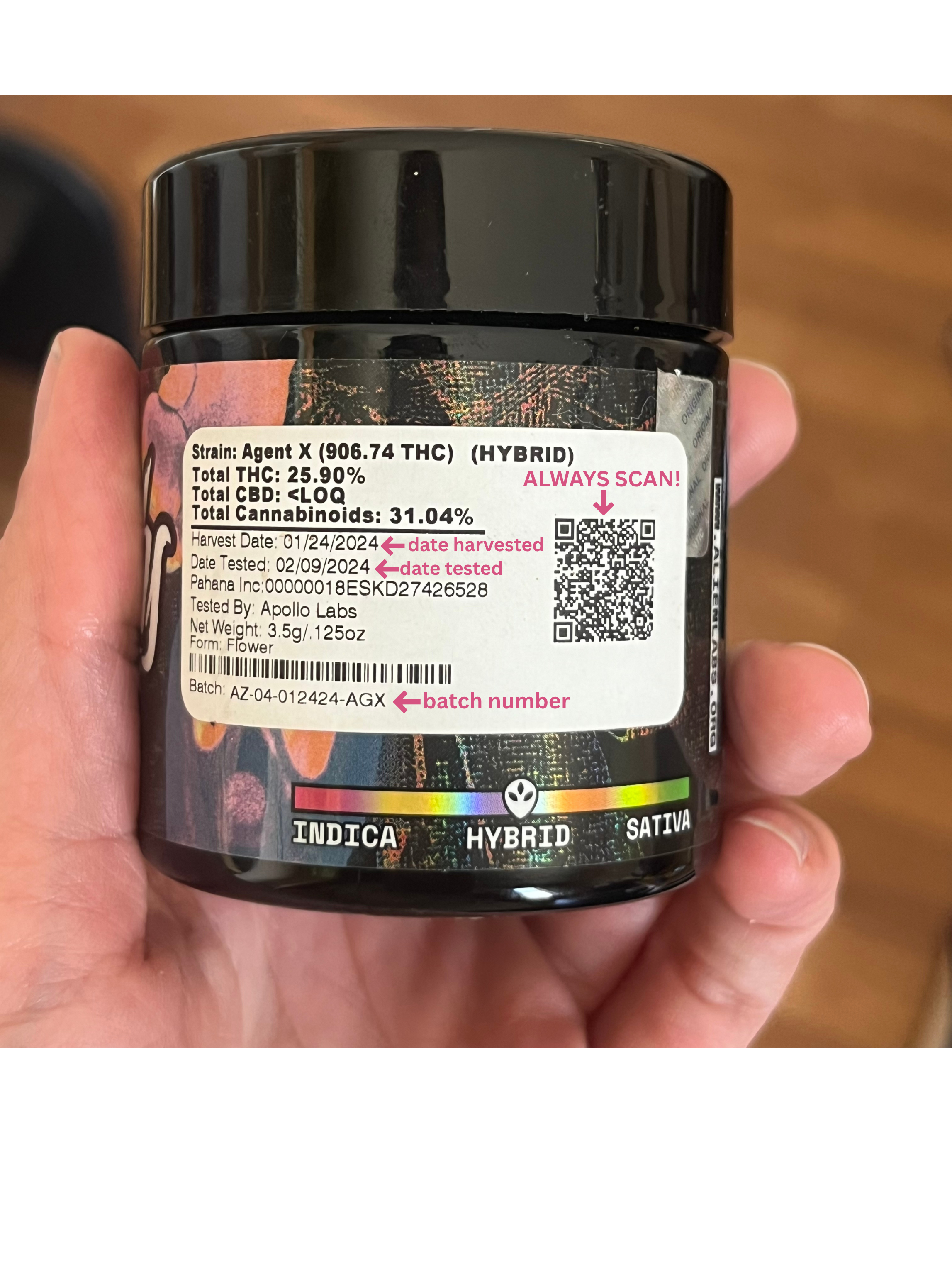
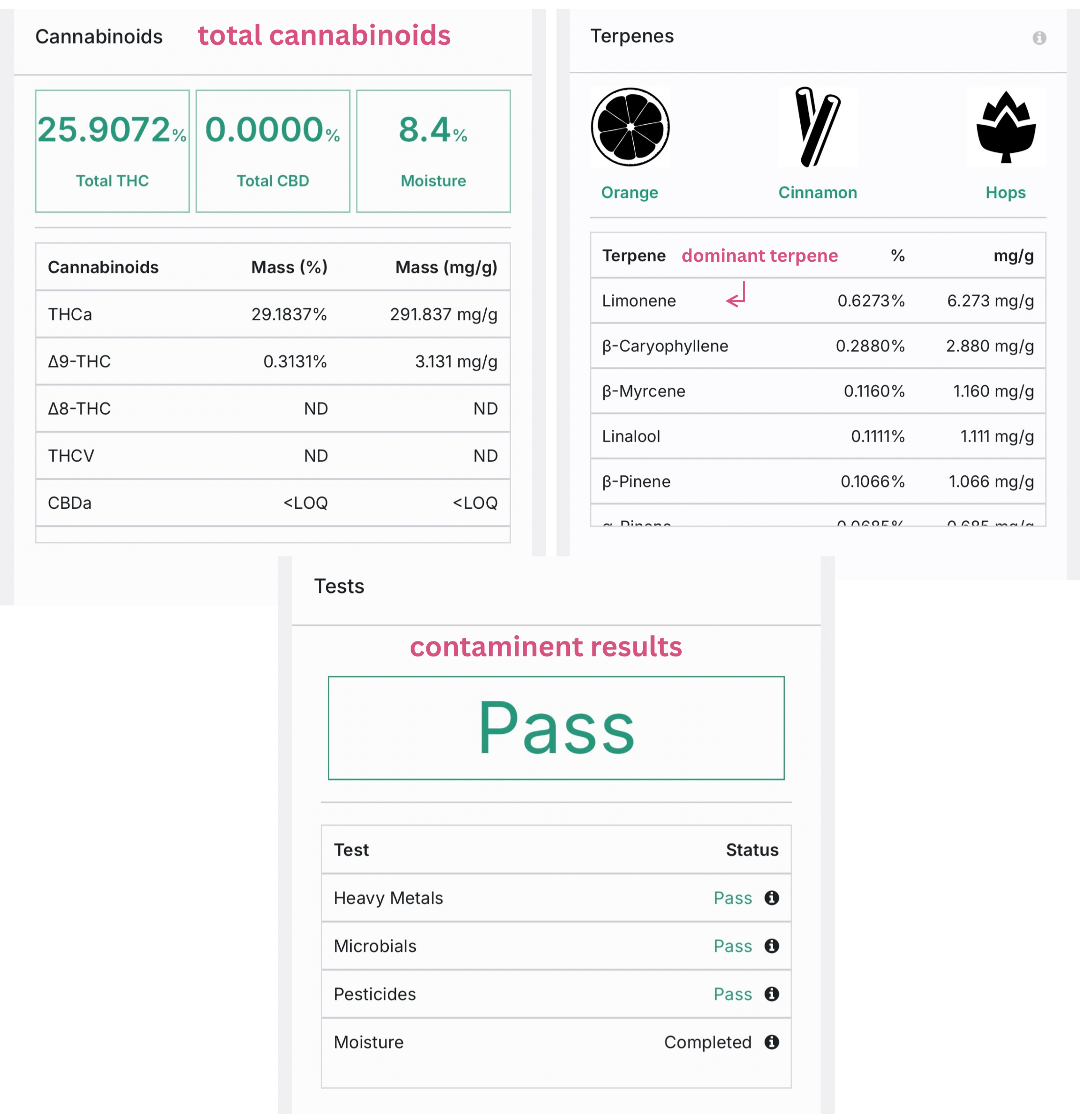
Okay, you've learned what terpenes are, what researchers are investigating, and why a terpene profile can be useful information without being a crystal ball. Now let's actually look at the paperwork.
A Certificate of Analysis (COA) is the laboratory report associated with a tested cannabis product or batch. Depending on the jurisdiction and product, it can tell you about cannabinoid and terpene content as well as testing for contaminants such as pesticides, heavy metals, microbial impurities, mycotoxins, and residual solvents or processing chemicals. And honestly? You do not need to understand every number on a COA to get useful information from one. Think of it as a report card for the product. You're looking for the pieces of information that actually help you understand what is in the product, how it was tested, and whether the batch passed the required safety testing.
🌿 TOTAL TERPENE PERCENTAGE
This tells you the combined amount of the terpenes detected by the laboratory.
You'll often see something like:
Total Terpenes: 2.8%
That doesn't mean 2.8% of the product is one terpene. It's the total of the individual terpenes reported on that test. And here's the important part: a higher total terpene percentage does not automatically mean a better product.
More terpene content isn't inherently “better,” just as a higher THC percentage isn't automatically better for every person or every situation. Terpenes also contribute to aroma and flavor, so total terpene content can tell you something about the chemical profile of the product, but it doesn't tell you exactly how that product will feel.
🔬 INDIVIDUAL TERPENE PERCENTAGES
This is where things get really interesting.
Don't stop at “Total Terpenes: 3%.” Look at which individual terpenes make up that number.
You might see:
β-Myrcene — 0.92%
β-Caryophyllene — 0.61%
Limonene — 0.48%
Linalool — 0.19%
α-Pinene — 0.11%
Now you have an actual terpene profile to work with.
The dominant terpenes can help you understand what compounds are contributing most to the product's aromatic and chemical profile. From there, you can compare that information with the research you've learned about on this page. But remember, presence does not equal effect. A terpene appearing on a COA doesn't mean you're guaranteed to experience the effect associated with it in a research study. The amount matters. The other compounds matter. Your biology matters. And the research itself matters.
🧬 LOOK AT THE CANNABINOID PROFILE, TOO
Never look at the terpene section in isolation.
Your COA may include:
THC
THCA
CBD
CBDA
CBG
CBC
and other minor cannabinoids
Depending on the product and the jurisdiction, the COA may report these in different ways. For example, as percentages for flower or milligrams per serving/package for manufactured products. This is important because a terpene profile doesn't exist in a vacuum. A product containing 2% limonene alongside a very different cannabinoid profile is not necessarily going to produce the same experience as another product containing 2% limonene. The whole profile matters.
📅 CHECK THE TESTING DATE
A COA should tell you when the sample was tested. Don't just ask, “Does this product have a COA?” Instead ask, “Does this COA actually correspond to the product and batch I'm looking at, and when was it tested?”
Testing requirements vary by jurisdiction, but regulated markets generally use batch-specific laboratory testing rather than treating one generic laboratory report as proof for every batch of a product. For example, California requires the COA to correspond to the correct batch and currently requires the distributor to verify that the COA is less than 12 months old.
If the package has a batch, lot, or production number, compare it with the number on the COA. Wrong batch = wrong report.
🧪 LOOK AT THE CONTAMINANT TESTING
This is the part I REALLY don't want people skipping just because the terpene section is more fun. Depending on the jurisdiction and product, laboratory testing may include things such as:
Pesticides
Were residual pesticides detected?
Heavy metals
Was the product tested for contaminants such as lead, arsenic, cadmium, or mercury?
Microbial impurities
Was the product screened for microbial contamination?
Mycotoxins
Was it tested for toxins produced by certain molds?
Residual solvents and processing chemicals
Especially relevant for products that have undergone extraction or other processing.
Regulated cannabis testing programs can require these categories specifically because a product's cannabinoid and terpene profile tells you what compounds are present, not whether the product is free from contaminants. So when you're reading a COA, don't just hunt for the prettiest terpene numbers. Look for the safety testing, too.
✅ PASS / FAIL MATTERS
You may see individual analytes with numbers, detection limits, action limits, or abbreviations such as LOD (limit of detection) and LOQ (limit of quantitation). You don't necessarily need to become a laboratory scientist to interpret every one of them. Start with the big question: did this batch pass the required testing?
In regulated testing systems, the COA reports whether the batch passes or fails the applicable testing requirements. If something says “detected,” don't automatically assume that means the product failed. Detection and passing/failing are not always the same thing, the applicable regulatory threshold matters. That's one reason I would prefer you look at the actual COA rather than rely on a pretty package claim or a marketing graphic.
🚨 DON'T CHOOSE A PRODUCT BASED ON “HIGHEST TERPENE PERCENTAGE”
This might be the biggest takeaway from this entire section: more ≠ better. A product with 5% total terpenes isn't automatically better than one with 2%. A product with the highest THC percentage isn't automatically better. A product with the longest terpene list isn't automatically better. And a product containing a terpene associated with a particular effect in research isn't automatically going to produce that effect for you. You're looking at a chemical profile, not a promise.
Instead, use the COA to ask better questions:
What cannabinoids are present?
Which terpenes are dominant?
How much of each terpene was detected?
Does the COA correspond to this exact batch?
When was it tested?
Did it pass the required contaminant testing?
Does the actual laboratory report match what the package is telling me?
That is what being a terpene nerd actually looks like. You're not chasing the highest number on the page. You're learning how to read the whole picture.
🧠 terpene myths: let’s separate the science from the sound bites
If you've spent any time researching cannabis, you've probably encountered some version of these statements:
“This terpene makes you sleepy.”
“That terpene cancels out THC.”
“Sativa gives you energy.”
“Indica gives you couch lock.”
Some of these ideas have roots in actual research. That's EXACTLY what makes them tricky.
A laboratory finding, an animal study, a theory about how compounds may interact, and a predictable effect in a human being are not the same thing. Terpene education gets much more useful when we learn to recognize the difference. So let's bust a few of the biggest myths.
-
This is one of the biggest oversimplifications in cannabis culture.
Indica and sativa are not reliable shorthand for a product's effects.
Historically, the terms referred to botanical classifications, but modern commercial cannabis has been extensively hybridized. Research has also found that commonly used labels such as “indica,” “sativa,” and strain names do not necessarily correspond neatly to the plant's underlying chemical composition. In other words, the name on the package can tell you much less about the actual chemistry than the cannabinoid and terpene profile can.
So instead of asking:
“Is this an indica or a sativa?”
a more useful question is:
“What is actually in this product?”
Look at the cannabinoids.
Look at the terpene profile.
Look at the dose.
Look at the route of administration.The label's category is not a guarantee of the experience.
-
You've probably heard the rule:
“High myrcene = couch lock.”
There is research describing myrcene as having sedative, analgesic, anti-inflammatory, and muscle-relaxant properties, which helps explain where this idea came from. But turning that research into a specific rule—like “above X% myrcene means you'll be sedated”—goes much further than the evidence allows.
A terpene percentage cannot account for the entire chemical profile, the cannabinoid content, dose, route, tolerance, or individual response.
So instead of:
“Myrcene = couch lock.”
Think:
“Myrcene has biological activity that researchers are investigating in relation to sedation, pain, inflammation, and other effects.”
That's a much more scientifically honest statement.
And ironically, it's more useful, because it leaves room for your actual experience instead of telling you what you're supposed to feel.
-
This one is particularly important because it gets repeated as though it has been clinically established.
Limonene has been investigated for anxiolytic and other neurobiological effects, and that makes it an interesting compound when researchers are studying stress and anxiety.
But “limonene may have anxiolytic activity” is not the same statement as “limonene cancels out THC-induced anxiety.”
Cannabis and THC can produce very different effects depending on dose, individual response, and other factors, and human research on cannabis and anxiety remains mixed.
There isn't enough human clinical evidence to tell someone:
“Just choose a limonene-rich product and it will prevent THC anxiety.”
That is a much bigger claim than the research supports.
So if you're looking at limonene because you're interested in the research surrounding stress or anxiety, that's a reasonable research-informed question.
Treating it like an anxiety-proofing switch?
Not supported.
-
This one is a great example of how a fascinating laboratory finding can become internet folklore.
Research has investigated α-pinene and β-pinene in relation to acetylcholinesterase, which is involved in cholinergic signaling and memory processes. Some cannabis literature has therefore proposed that pinene could potentially counteract certain cognitive effects associated with THC.
But that hypothesis has not been established as a clinical rule in humans.
Meanwhile, the effects of THC on memory and cognition themselves are well documented enough that we should not tell someone that a pinene-rich product somehow makes those effects disappear. Human studies and systematic reviews have found acute THC-related impairment in aspects of memory and attention, although the magnitude and persistence of effects vary with dose, timing, and other factors.
So:
“Pinene may be involved in pathways relevant to cognition”
is very different from:
“Pinene prevents THC memory impairment.”
The first is a research question.
The second is a promise.
-
Nope.
A product containing 5% total terpenes isn't automatically “better” than one containing 2%.
More isn't inherently better.
More THC isn't inherently better.
More CBD isn't inherently better.
More terpenes aren't inherently better.What matters is what you're actually looking for, what the entire chemical profile contains, how the product is being used, and how your body responds to it.
And remember what we talked about in the COA section:
A number is information—not a ranking.
A high terpene percentage can tell you that a product contains a relatively large amount of those compounds.
It cannot tell you that the product will produce a better experience, a stronger therapeutic effect, or a safer experience.
-
This is the cannabinoid version of the “more terpenes = better” myth.
A product containing 30% THC isn't automatically better than one containing 20%.
A product containing 10% CBD isn't automatically better than one containing 5%.
Higher concentration simply means higher concentration.
And when we're talking about THC in particular, more can sometimes mean more unwanted effects, especially when high-potency products are used frequently or in large amounts.
This becomes particularly important when we talk about concentrates.
Some cannabis concentrates can contain extraordinarily high THC concentrations—far beyond what is found in traditional flower. Researchers have raised concerns about the potential health consequences of increasingly potent cannabis products, including their relationship with problematic use and other adverse effects.
There is also an important connection here to cannabinoid hyperemesis syndrome (CHS).
CHS is a condition characterized by recurrent episodes of severe nausea, vomiting, and abdominal pain associated with regular cannabis use. Research consistently identifies frequent or prolonged cannabis use among people who develop CHS, and several reviews have raised the possibility that escalating exposure to high-potency THC may contribute to risk. However, the exact mechanism of CHS is still not completely understood.
That means we should be careful about turning this into:
“High THC causes CHS.”
The evidence isn't that simple.
But it is absolutely reasonable to recognize that high-potency products and frequent, heavy use are important parts of the CHS conversation.
And this is exactly why I keep telling you to read your COA.
🧪 POTENCY IS ONLY ONE PIECE OF THE PRODUCT.
A COA can help you understand:
cannabinoid concentrations
terpene concentrations
batch information
testing dates
and, depending on the jurisdiction and product, contaminant testing
And that last part matters.
A beautiful terpene profile doesn't tell you whether a product passed its required pesticide, heavy-metal, microbial, mycotoxin, or residual-solvent testing.
Don't let a percentage become the only thing you look at.
The goal isn't to find the product with the biggest number.
It's to understand what you're actually putting into your body.
-
This one goes too far in the opposite direction.
Terpenes absolutely contribute to the aroma and flavor of cannabis—but that's not necessarily all they do.
Researchers are studying terpene activity across a huge range of biological pathways, including inflammation, pain, anxiety-related behavior, antimicrobial activity, sedation, and interactions with the endocannabinoid system. Some of those findings are quite interesting.
The catch?
“Biologically active” does not automatically mean “clinically proven.”
A compound can demonstrate an effect in a cell study, animal model, isolated-tissue experiment, or laboratory assay without us knowing whether the same thing happens in a human being consuming a real-world cannabis product.
That distinction is one of the most important things I want you to take away from this entire page.
Terpenes aren't “just flavor.”
But they also aren't tiny prescription bottles hiding inside your flower.
They're biologically active plant compounds that researchers are still working to understand.
-
Not necessarily.
Two products can both list β-caryophyllene as their dominant terpene while having completely different amounts of THC, CBD, minor cannabinoids, other terpenes, and total terpene content.
They can also differ in dose, formulation, route of administration, and how quickly those compounds reach the body.
So:
Same dominant terpene ≠ same product.
This is exactly why I keep bringing you back to the whole profile.
-
This might be the biggest myth of all.
A study doesn't exist in a vacuum.
Before you turn a research finding into a statement about what a terpene “does,” ask:
What was actually studied?
Was it:
an isolated terpene?
a cannabis extract?
whole-plant cannabis?
a cell culture?
an animal?
a human?
a pregnant human?
a specific dose?
a specific route of administration?
Those details can completely change how much weight we should give a finding.
A mouse study showing an interesting effect isn't useless.
A cell study isn't useless.
A laboratory study isn't useless.
They're pieces of the research process.
But they aren't permission slips to skip the rest of the research process.
-
Let's slow this one down.
Cannabis contains biologically active compounds that have demonstrated therapeutic potential, and specific cannabinoid-based medicines have established medical applications. Researchers continue to study cannabis and its constituents across a wide range of symptoms and conditions.
But “has therapeutic potential” and “is completely risk-free” are two very different statements.
And pregnancy makes this distinction even more important.
If cannabis is being considered as an option in a situation where other treatment approaches have not provided adequate relief, harm reduction becomes incredibly important.
That means looking beyond:
“This is natural.”
or:
“This terpene is supposed to help.”
Instead, consider the entire product.
Where did it come from?
What exactly is in it?
How potent is it?
Which cannabinoids are present?
Which terpenes are present?
Are those terpenes naturally occurring in the plant or were they added?
Does the product have a legitimate COA?
Does that COA correspond to the actual batch?
Did the product pass the applicable contaminant testing?
What is known about the route, dose, and frequency of use?
Because unless you're growing and processing your own plant under controlled conditions, you don't personally control everything that went into the final product.
Cannabis can be exposed to contaminants during cultivation, processing, manufacturing, storage, or handling. That's one reason regulated testing exists in the first place.
And even when a product is completely free of detectable contaminants, that doesn't make it 100% risk-free.
Nothing is.
Not cannabis.
Not pharmaceuticals.
Not supplements.
Not essential oils.
Not “natural” remedies.Especially during pregnancy, the useful question isn't:
“Is this completely risk-free?”
It is:
“What are the known and potential risks, what are the potential benefits, what alternatives exist, and how can we reduce avoidable risk as much as possible?”
If cannabis is part of that conversation, know your product inside and out.
Read the COA.
Understand the cannabinoids.
Understand the terpene profile.
Understand the potency.
Understand how the product was made.
And don't let one percentage—or one appealing terpene—make the entire decision for you.
-
This one needs a little more nuance than simply saying “natural doesn't mean safe.”
Because there is a really important distinction between:
a terpene naturally occurring within the chemistry of a plant
and
a concentrated terpene that has been isolated, extracted, blended, or added to a finished product.
Those are not automatically equivalent exposures.
Think about it this way:
A cannabis plant naturally produces terpenes within its flowers. The amount and combination of those compounds are part of that plant's overall chemical profile. Cannabis can contain more than 100 identified terpenoid compounds, with the specific profile varying between varieties and growing conditions.
But manufacturers can also work with isolated or concentrated terpene preparations, including cannabis-derived, botanical, or synthetic terpene blends. These can be added to manufactured cannabis products for reasons including aroma, flavor, formulation, or other product characteristics.
So when you're looking at a product containing limonene, linalool, pinene, or another familiar terpene, don't stop at:
“I've heard that terpene is found in lavender/oranges/pepper/pine, so it must be safe.”
Ask a much better question:
“Is this terpene naturally occurring in the plant material, or was it added to the product?”
And then:
“If it was added, what exactly was added, at what concentration, and why?”
That distinction matters because the presence of a compound somewhere in nature doesn't tell you what happens when that compound is isolated, concentrated, formulated into another product, or consumed at a different dose and by a different route.
A terpene occurring naturally in cannabis is also not automatically a guarantee of safety during pregnancy.
But neither should we pretend that finding a terpene on a cannabis COA tells us the same thing as deliberately adding a concentrated terpene preparation to a product.
Context matters. Dose matters. Route matters. Formulation matters. And the actual product matters.
So when you're evaluating a product, don't just ask:
“What terpenes are in this?”
Ask:
“Where did those terpenes come from?”
🌿 NATURALLY OCCURRING ≠ ADDED ≠ ISOLATED
These terms can get tossed around as though they're interchangeable.
They're not.
Naturally occurring:
The compound is part of the plant's native chemical profile.Cannabis-derived:
The compound was obtained from cannabis—but may have been extracted, isolated, concentrated, or otherwise processed.Botanical-derived:
The compound came from another plant source.Synthetic:
The compound was produced through chemical synthesis rather than extracted from a plant.And importantly, “natural” or “cannabis-derived” doesn't automatically answer the safety question.
It simply gives you information about the source.
That's why I want you to become comfortable asking for the actual product information and COA, rather than relying on words like “natural,” “botanical,” or “all-natural” on a marketing label.
-
Science rarely works that way.
A terpene isn't automatically safe because it occurs naturally.
But the absence of pregnancy-specific clinical research also doesn't automatically prove that the compound is dangerous.
There is a massive middle ground between:
“This is completely harmless.”
and
“This is definitely dangerous.”
That's where a lot of terpene research currently lives.
Some compounds have interesting preclinical data. Some have human data in completely different contexts. Some have barely been studied. Some have extensive evidence in food or other common exposures but much less information about concentrated preparations.
So rather than assigning every terpene a simplistic SAFE / UNSAFE label, I want this page to teach you how to look at the actual evidence and the actual product.
🧠 THE REAL LESSON
The problem with most terpene myths isn't necessarily that they came from nothing. It's that a complicated research finding gets compressed into a sentence that sounds much more certain than the evidence actually is.
“Researchers are investigating whether myrcene has sedative properties” becomes:
“Myrcene makes you sleepy.”
“Limonene has demonstrated anxiolytic activity in some models” becomes:
“Limonene cancels THC anxiety.”
“Pinene interacts with pathways involved in cognition” becomes:
“Pinene prevents the memory effects of THC.”
That's how interesting science turns into cannabis folklore. And I don't think you need to throw the interesting science away just because the internet got carried away with it. We just need to put the uncertainty back where it belongs.
So when you see a terpene claim, ask yourself:
🔎 WHAT DOES THE RESEARCH ACTUALLY SAY?
What compound was studied?
At what dose?
In what model?
Was it isolated or part of a whole product?
Was it tested in humans?
Has the finding been replicated?
And most importantly: does the evidence actually support the claim being made?
Because “promising,” “interesting,” “associated with,” “demonstrated in a preclinical model,” and “clinically established” are not interchangeable. That's the difference between reading terpene marketing... and becoming a terpene nerd. 🌿
🧠 THE BIGGER POINT
And this is why I don't want you walking away from this page thinking: “I need the highest THC.”
or: “I need the highest CBD.”
or: “I need the highest terpene percentage.”
or even: “I need this one specific terpene.”
Those are all shortcuts. And shortcuts are exactly where terpene education can start becoming misinformation. The goal isn't to find the magic number or the magic terpene. If cannabis is being considered as part of a symptom-management conversation, particularly during pregnancy, harm reduction means looking at the whole picture.
That means considering:
Product potency.
Cannabinoid profile.
Terpene profile.
Whether those terpenes are naturally occurring or added.
Product formulation.
Testing and contaminants.
Dose.
Route.
Frequency.
Individual response.
And the alternatives that are available.
One piece of information should inform the conversation. It shouldn't replace the conversation.
🌿 THE GOAL ISN'T TO FIND A “RISK-FREE” PRODUCT.
The goal is to become informed enough to recognize where avoidable risk may exist, understand what is actually known about the product you're considering, and make more informed decisions with the information available to you. Because natural doesn't automatically mean safer. High percentage doesn't automatically mean better. A terpene appearing on a label doesn't automatically mean it will produce the effect associated with it in a study. And one pretty number on a label should never be allowed to tell the whole story.
Read the research. Read the label. Read the COA.Know your product.
And most importantly, know the difference between what the science has actually demonstrated and what someone on the internet says it means. That's where terpene education becomes more than memorizing which plant smells like what.
THAT’S informed decision-making. 🌿
🔬 evidence levels: how much we actually know
One of the biggest problems with cannabis research isn't that there isn't research. It's that people don't always tell you what kind of research they're talking about. You'll see a headline that says: “Researchers found that limonene reduces anxiety.”
That sounds pretty definitive. But what if the study was performed on mice? Or isolated cells? Or used a concentrated dose of purified limonene? Or looked at a completely different route of administration? Or never involved cannabis at all?
Those details matter. A lot. So throughout this page, I want to make something really clear: Not all evidence answers the same question.
A laboratory study can tell us that something can happen under certain experimental conditions. An animal study can tell us more about how a compound behaves in a living organism. A human study can tell us more about what happens in people. And pregnancy-specific human research can begin to answer questions that simply cannot be answered by a study conducted in cells, mice, or non-pregnant adults. That doesn't mean one level of research is automatically “good” and another is automatically “bad.” It means the question you can reasonably answer depends on the evidence you actually have.
🧠 THE EVIDENCE LADDER
For this section, you'll see me use four simple evidence markers:
🧫 LABORATORY RESEARCH
Cells, tissues, receptors, biochemical models
**Useful for understanding mechanisms and generating hypotheses.
🐁 PRECLINICAL RESEARCH
Animal or other non-human models
**Useful for studying biological effects in living organisms before human research.
👩🔬 HUMAN RESEARCH
Clinical or observational studies in people
**More directly relevant to human effects, but study design and quality still matter.
🤰 PREGNANCY-SPECIFIC RESEARCH
Human research specifically involving pregnancy
**The most directly relevant category when we're asking pregnancy-specific questions—but even here, study design, sample size, exposure, and outcomes matter.
🧫 LABORATORY RESEARCH
What is it?
Research conducted using things like isolated cells, tissues, receptors, enzymes, or biochemical systems. You may also see this called in vitro research.
What can it tell us?
Laboratory research can help scientists understand:
whether a compound interacts with a particular receptor or pathway
whether it changes cellular activity
whether it has antioxidant, inflammatory, antimicrobial, or other measurable activity
what mechanisms might be worth investigating further
This type of research is incredibly useful for generating hypotheses. For example, if an isolated terpene changes an inflammatory pathway in a laboratory model, researchers now have a reason to investigate that compound more closely.
What can't it tell us?
It cannot tell us that consuming a cannabis product containing that terpene will produce the same effect in a human being. It also cannot tell us that a particular dose is effective or safe during pregnancy. A cell is not a pregnant person. That sounds obvious, but it's an incredibly important distinction when reading cannabis headlines.
🐁 PRECLINICAL RESEARCH
What is it?
Research conducted before large-scale human clinical testing, often using animal models. You may see studies involving mice, rats, or other laboratory animals.
What can it tell us?
Animal studies allow researchers to investigate things that are much more difficult to study in isolated cells. They can help researchers examine:
behavior
pain responses
inflammation
anxiety-like behavior
sleep or sedation
metabolism
organ effects
reproductive or developmental effects
This can provide valuable information about how a compound might behave in a living organism.
But here's the catch:
An animal response is not automatically a human response. Species metabolize compounds differently. Doses may not translate directly. Routes of administration may differ. And an experimental dose of an isolated terpene may have very little resemblance to the concentration someone encounters in a real-world cannabis product.
So when you see: “Myrcene reduced pain in mice.”
The scientifically honest translation is “Myrcene demonstrated an analgesic effect in that animal model under those experimental conditions.”
That's interesting. It absolutely deserves more research. But it isn't the same as: “Myrcene treats pain in humans.” And it certainly isn't: “Myrcene treats pregnancy-related pain.”
👩🔬 HUMAN RESEARCH
Now we're getting closer to the questions most people actually want answered. Human research can include several different types of studies, including:
clinical trials
observational studies
cohort studies
case-control studies
pharmacokinetic studies
surveys and patient-reported outcomes
And here's another important lesson: “Human study” does not automatically mean “proven.”
A randomized controlled trial and a small observational survey can both be human research while providing very different kinds of evidence. For example, an observational study may identify an association between cannabis exposure and an outcome. That can be important information. But an association does not automatically prove that cannabis caused the outcome. Researchers have to consider things like:
confounding factors
dose
frequency of use
route of administration
timing
co-use of tobacco or other substances
underlying health conditions
differences between products
This is especially important in pregnancy research, where deliberately assigning pregnant participants to potentially harmful exposures is considered to be generally not an ethical research design. As a result, much of the available pregnancy literature is observational, and researchers continue to identify important limitations and unanswered questions. Recent systematic reviews have found associations between prenatal cannabis exposure and several adverse pregnancy or neonatal outcomes, while also emphasizing limitations such as heterogeneity and difficulty separating characteristics of cannabis exposure. So when you see “human research,” don't stop there. Ask: “What kind of human research?”
🤰 PREGNANCY-SPECIFIC HUMAN RESEARCH
This is the category I especially want pregnant patients to pay attention to. Because if we're asking: “What does this mean during pregnancy?” then eventually we need research that actually includes pregnant people.
And this is where pregnancy research gets complicated, not because pregnant people are incapable of participating in ethical research, but because historically, researchers and regulators have often taken a highly protectionist approach to pregnancy. That approach was shaped in part by tragedies such as thalidomide. But here's the part of that history that gets lost: Thalidomide was not a disaster caused by pregnant women participating in a clinical trial.
Thalidomide was prescribed to pregnant women its devastating effects on fetal development were understood. The resulting tragedy contributed to a research culture that became extremely cautious about exposing pregnant people to experimental treatments. And that caution had consequences of its own.
Pregnant people were routinely excluded from clinical research, leaving clinicians and patients with limited pregnancy-specific information about medications that pregnant patients may nevertheless need to take. Reviews of the research landscape have described pregnancy therapeutics as severely understudied, and one review found that 95% of a sample of clinical trials for novel drugs submitted to the FDA excluded pregnant participants. That creates a difficult paradox: We exclude pregnant people from research in an effort to protect them from unknown risks—and then ask pregnant people to make real medical decisions without the evidence that research could have provided.
That isn't a reason to throw ethics out the window. It's a reason to do pregnancy research better.
🧬 PREGNANCY IS NOT A REASON TO STOP ASKING RESEARCH QUESTIONS.
There are absolutely situations where exposing a pregnancy to an experimental intervention would not be ethically justified.
But “pregnant” should not automatically mean “ineligible for research.”
The FDA now explicitly recognizes that there are circumstances in which inclusion of pregnant women in clinical trials can be scientifically and ethically appropriate, and its guidance calls for an informed, balanced approach to generating pregnancy-specific data. More recent ethical frameworks have gone even further, arguing that routine exclusion can itself conflict with principles of autonomy, beneficence, and justice, and that researchers should consider whether excluding pregnant people is actually justified for the specific study. In other words: The ethical question shouldn't simply be “Could this intervention possibly pose a risk?” Because nearly every meaningful medical intervention has some risk. The questions should also include:
What is the potential benefit?
What are the known risks?
What are the unknown risks?
What alternatives already exist?
What risks does leaving the condition untreated create?
Can the study be designed to minimize exposure and protect participants?
Can meaningful pregnancy-specific information be collected without unnecessarily exposing participants to risk?
And what happens when we continue not to collect that information?
💊 HOW DO WE KNOW SO MUCH ABOUT SOME MEDICATIONS IN PREGNANCY?
This is where the phrase “we can't ethically test medications in pregnant people” becomes particularly misleading. We do conduct research involving pregnancy. And pregnant people receive medications every day, sometimes medications with extensive pregnancy-specific evidence, sometimes medications supported by observational data, registries, pharmacovigilance, post-market surveillance, or studies conducted after the medication is already being used in pregnancy. The problem is that many medications still enter widespread clinical use with limited pregnancy-specific evidence.
Researchers have described this as a major evidence gap: pregnant people may need treatment, but the evidence necessary to determine optimal dosing, effectiveness, and risks during pregnancy is often incomplete.
And that means the absence of a pregnancy trial doesn't necessarily mean: “Doctors don't use this during pregnancy.”
Sometimes it means: “Doctors use this because the potential benefits and existing evidence are considered sufficient for the clinical situation, even though pregnancy-specific evidence remains limited.”
That distinction is huge.
🤰 AND THIS IS WHERE PATIENT-CENTERED CARE MATTERS
A pregnant patient shouldn't have to choose between: “Take this medication. Don't worry about it.”
and: “There isn't enough research, so there's nothing we can tell you.”
There is a middle ground.
Patients deserve to know:
What do we actually know?
What don't we know?
What evidence comes from pregnancy?
What evidence comes from non-pregnant adults?
What are the known potential risks?
What are the potential benefits?
What alternatives exist?
What symptoms or condition are we trying to treat?
What happens if we don't treat it?
And, when appropriate: What harm-reduction strategies can reduce avoidable exposure or risk?
THAT’S informed consent.
🔬 SO WHAT DOES THIS MEAN FOR TERPENE RESEARCH?
This is particularly important when we're talking about cannabis. If a study shows that an isolated terpene affects an inflammatory pathway in cells, that's useful information. If an animal study suggests that a terpene may influence pain, anxiety-like behavior, nausea-related pathways, or sleep, that's useful information too. If a human study finds a particular effect in non-pregnant adults, that's another piece of the puzzle. But if the question is: “What does this terpene do in a pregnant human who is using a real-world cannabis product?” then we need evidence that actually gets closer to answering that question. And right now, pregnancy-specific research on individual cannabis terpenes is extremely limited.
That doesn't mean: “Therefore, the terpene is unsafe.”
It also doesn't mean: “Therefore, the terpene is safe.”
It means: “We have an evidence gap.”
And an evidence gap is something researchers should be working to close, not something patients should be expected to pretend doesn't exist.
🧠 THE POINT OF THIS ENTIRE EVIDENCE LADDER
I don't want you to look at these categories and think:
🧫 = useless
🐁 = useless
👩🔬 = proven
🤰 = perfect
That's not how science works.
Instead, think of them as answering different questions.
🧫 LABORATORY RESEARCH
**Can we observe this biological activity under controlled conditions?
🐁 PRECLINICAL RESEARCH
**Does this appear to produce an effect in a living organism?
👩🔬 HUMAN RESEARCH
**Does this finding appear relevant to people?
🤰 PREGNANCY-SPECIFIC RESEARCH
**Does this evidence actually tell us something about pregnancy?
And even within each category, study design, dose, route, population, sample size, comparison group, and outcome all matter. The closer the research matches the question you're actually asking, the more directly you can apply it.
🌱 AND THAT'S THE PART I WANT YOU TO REMEMBER:
Pregnancy doesn't make research impossible. Pregnancy makes good research especially important. Because when pregnancy is excluded from research, the need for information doesn't disappear.
The medical decisions still happen. The medications still get prescribed. The symptoms still need treatment. The risks of untreated illness are still real. And patients are still left trying to make decisions with whatever evidence happens to exist. The answer to an evidence gap shouldn't be pretending the gap doesn't matter. It should be better research, better disclosure of uncertainty, better patient education, and better informed consent.
And when we're talking about terpenes, that's exactly what this evidence ladder is here to help you understand:
What do we actually know?
How do we know it?
Who was studied?
What exactly was studied?
And how closely does that evidence match the question you're trying to answer?
🌿 “terpene profiles” instead of strain names
If there's one habit I hope you take away from this entire page, it's this:
Stop asking only: “What strain is this?”
And start asking: “What's actually in it?”
Because a cultivar name can be useful for identifying what a product is called—but the name itself doesn't tell you the complete chemical composition of what's in the package. And that's a pretty important distinction.
🌱 A NAME ISN'T A CHEMICAL PROFILE
“Blue Dream.”
“OG Kush.”
“Girl Scout Cookies.”
“Purple Haze.”
“Indica.”
“Sativa.”
You've probably heard dozens of these names. They can be useful shorthand within cannabis culture, and sometimes products carrying the same name do show similarities in their chemical profiles. But here's the problem: There is no universally standardized system that makes a cultivar name a guaranteed chemical fingerprint.
Research has found substantial variation in cannabinoid and terpene profiles among products sharing the same reported cultivar or “strain” name. Researchers have also found that widely used categories such as “indica” and “sativa” do not reliably correspond to distinct chemical profiles. Even plants carrying the same cultivar name can show variation because of genetics, growing conditions, processing, storage, and other factors.
So when someone says: “That strain always makes me sleepy.”
there's a missing question: “Which version of that cultivar, from which producer, from which batch, with what chemical profile?”
Because those details can matter.
🧪 THINK CHEMOVAR, NOT JUST “STRAIN”
You may see the word chemovar used in cannabis research. It's short for chemical variety, and it's a way of describing cannabis based on its chemical characteristics rather than relying primarily on a commercial or breeder-reported name. That's much closer to the philosophy we're building here.
Instead of thinking: “This is the sleepy strain.”
We can start thinking: “This product has this cannabinoid profile, this terpene profile, and this particular chemical fingerprint, and this is how I personally responded to it.”
That's a much more useful conversation.
Researchers studying commercial cannabis have specifically argued that chemical profiling can provide more meaningful information than relying on cultivar names alone, because the relationship between names and actual chemical composition isn't consistently reliable. And this is exactly where your COA becomes useful.
🔬 YOUR PRODUCT HAS A CHEMICAL STORY
Remember the COA section? This is where everything starts coming together.
Instead of recording only:
Cultivar: Blue Dream
You could document:
Cultivar: Blue Dream
THC: XX%
CBD: XX%
Dominant terpenes: Limonene, β-Myrcene, β-Caryophyllene
Total terpenes: X%
Batch: XXXXX
Personal response: Relaxed, functional, appetite increased
Now you've created something much more informative than a strain name. You've created a product profile. And if you encounter another product six months later with the same cultivar name but a completely different terpene profile? You have a reason to expect that your experience might differ. Not because the terpene profile guarantees an effect. But because you're no longer pretending the name tells you everything.
🧠 THIS IS WHERE YOUR PERSONAL DATA BECOMES USEFUL
One of my favorite things about terpene education is that it gives you a way to become a better observer of your own response without turning your experience into universal medical advice.
Instead of: “Limonene makes me happy.”
You can say: “I've noticed that products I've personally responded well to have consistently contained limonene among their dominant terpenes.”
Those are VERY different statements. The first turns a personal observation into a universal promise. The second gives you a pattern you can continue investigating. And THAT, friends, is where keeping notes can become genuinely useful.
Consider tracking:
🌿 Cultivar name
🧪 Cannabinoid profile
👃 Dominant terpenes
📊 Total terpene percentage
🏷️ Producer / brand
🔢 Batch or lot number
💨 Route of administration
⚖️ Approximate dose
⏰ Timing
🧠 What you were hoping to address
🌱 What you actually experienced
⚠️ Any unwanted effects
⏳ How long the effects lasted
Over time, you may start seeing patterns that a cultivar name alone could never show you.
👀 “BUT I ALWAYS GET THE SAME EFFECT FROM THAT STRAIN.”
You might! And your experience is still valuable. If you've purchased the same cultivar repeatedly and consistently noticed a similar response, that's worth paying attention to. But there are two different things happening: Your experience can be real.
AND: Your explanation for that experience can still be incomplete.
Maybe the cultivar genuinely has a relatively consistent chemical profile from the producer you buy it from. Maybe a particular combination of cannabinoids and terpenes contributes to your experience. Maybe dose, route, tolerance, timing, setting, expectations, or another factor is contributing. Maybe it's some combination of all of those things. Which is why I'm not interested in replacing one oversimplification with another.
We're not going from: “Strains determine everything.”
To: “Terpenes determine everything.”
We're going from: “The name tells me what this will do.”
To: “The chemical profile gives me more information to work with.”
🌿 SO WHAT SHOULD YOU LOOK FOR?
When you're evaluating a cannabis product, think about the information in layers:
CULTIVAR NAME
Useful for identification and personal history.
But don't treat it as a guaranteed chemical profile.
CANNABINOID PROFILE
Look beyond simply “THC.”
Depending on the product and testing, you may see cannabinoids such as:
THC / THCA • CBD / CBDA • CBG / CBGA • CBC • CBDV • CBN • THCV
The exact panel varies by product and laboratory.
TERPENE PROFILE
Look at which terpenes are actually present and which ones are dominant.
Myrcene? Limonene? β-Caryophyllene? Linalool? Pinene? Humulene? Terpinolene? Something less familiar?
Now we're getting somewhere.
TOTAL TERPENES
This tells you the combined concentration of the terpenes detected by the laboratory.
But remember:
More isn't automatically better.
A higher total terpene percentage doesn't guarantee a better experience, stronger effect, or better product.
THE COA
Now you can verify that the numbers you're looking at correspond to the actual product and batch.
And depending on the jurisdiction and product, the COA may provide additional information about contaminant testing and other quality-control measures.
YOUR OWN RESPONSE
This is the piece a laboratory report can't give you.
What happened when you used that particular product, at that particular dose, through that particular route, under those particular circumstances?
That's your personal data.
🧩 THE “SAME STRAIN” TEST
Here's a fun way to put this philosophy into practice. The next time you encounter the same cultivar name from two different producers, don't assume they're identical. Compare the labels. Then compare the COAs if they're available.
Look at:
THC
CBD
Minor cannabinoids
Dominant terpenes
Total terpenes
Batch information
You may find that two products carrying the same name have surprisingly different chemical profiles. And that's exactly why “What strain is it?” can be a much less useful question than people realize. The name tells you what someone called it. The lab report tells you more about what was actually measured.
🌱 FROM “STRAIN CHASING” TO PROFILE TRACKING
This doesn't mean you have to stop enjoying cultivar names. I actually enjoy knowing the name of what I'm growing or using. Names have history. They have culture. They can help you remember what you liked. They can help you find a particular cultivar again. But I don't want the name to be the end of the conversation. I want it to be the beginning.
Instead of: “I need that strain because it helps with X.”
Try: “I had a good experience with that product. What was actually in it?”
Then look!
Maybe the product was THC-dominant. Maybe it had a meaningful amount of CBD. Maybe β-Caryophyllene was one of the dominant terpenes. Maybe it had a surprisingly high amount of linalool. Maybe the total terpene content was modest but the profile was distinctive. Maybe another product carrying the exact same cultivar name has a completely different profile. That's information.
And information gives you something much better than a catchy name: Something you can actually investigate.
🧠 THE BIGGER LESSON
This entire page has been about moving away from simplistic cannabis education.
Not: “THC = high.”
Not: “CBD = safe.”
Not: “Indica = sleepy.”
Not: “Sativa = energetic.”
Not: “Limonene = happy.”
Not: “Myrcene = couch-lock.”
And not: “This strain works for everyone because it worked for me.”
Instead:
“Here's what was actually measured.”
“Here's what the research has investigated.”
“Here's what we know.”
“Here's what we don't know.”
“And here's what happened in my own experience.”
That is a MUCH more useful framework for anyone trying to make an informed decision about cannabis. And especially when the stakes are higher, like during pregnancy, that distinction between a name, a chemical profile, a research finding, and a personal experience becomes even more important.
🌿 YOUR NEW TERPENE NERD FORMULA
So if you remember absolutely nothing else from this page, remember this:
Don't just ask what it's called. Ask what's in it.
Don't just ask what's in it. Ask what was actually measured.
Don't just ask what was measured. Ask what the research can actually tell you about it.
And don't confuse someone else's research, or your own experience, with a guarantee for someone else.
Your goal isn't to become a walking encyclopedia of strain names. Your goal is to become a better reader of the plant.
Cultivar name + cannabinoid profile + terpene profile + COA + dose/route + personal response.
THAT’s the information I want you taking with you. Because when you know what you're actually looking at, you can ask better questions. And better questions are where informed decision-making begins. 🌿
🌱 the terpene takeaway
You don't have to memorize every terpene in cannabis. You don't have to be able to identify a plant by smell. And you definitely don't need to become a walking encyclopedia of strain names. What I do want you to walk away with is a better way to think about cannabis chemistry.
Start by asking:
What's actually in this product?
Look beyond the name. Look at the cannabinoid profile. Look at the terpene profile. Look at the COA. Look at the dose, route, and formulation. And then ask what the research actually tells us about those compounds, not what a marketing graphic says they're supposed to do.
Because there's a huge difference between: “Researchers are investigating this.”
And: “This is proven to do this.”
There's also a difference between: “This is what happened in my experience.”
And: “This will happen to you.”
Those distinctions matter. Especially when we're talking about pregnancy, breastfeeding, medications, or anyone navigating a health condition where the stakes are higher.
🌿 YOU DON'T NEED TO KNOW EVERYTHING. YOU JUST NEED TO KNOW HOW TO ASK BETTER QUESTIONS.
You now know that cannabis contains far more chemistry than THC and CBD. You know that terpenes contribute to the plant's aroma and flavor and are being investigated for a wide range of biological effects. You know that a terpene profile is a clue, not a guarantee. And you know that a cultivar name alone doesn't tell you everything that's actually in the product.
That's enough to start.
You don't need certainty to become more informed. You need better information. You need to know what was studied. You need to know what wasn't. You need to recognize when someone has taken an interesting finding and turned it into a promise the research doesn't actually support. And you need to be comfortable saying: “We don't know yet.”
That's not a failure of science. That’s not a failure of informed choice. That's an honest description of where the evidence currently is.
🌱 KEEP EXPLORING
If you want to go back through the individual terpene profiles, you can jump straight to: Myrcene | Limonene | β-Caryophyllene | Linalool | α-Pinene | Terpinolene | Humulene | Ocimene
And if you're interested in seeing what this looks like when terpene education moves from the plant itself into a finished consumer product, I'll also be breaking down MONDAYS in a separate deep-dive blog. That deserves its own conversation. 🌿
⚠️ a note before you go
THIS PAGE IS FOR EDUCATIONAL PURPOSES ONLY
This page is provided for educational and informational purposes only. It is not medical advice.
I am a cannabis and patient-centered advocate, not a physician, pharmacist, midwife, lactation consultant, or other licensed medical professional. I'm sharing research, educational resources, and my own experience and education, not diagnosing or prescribing for you.
Nothing on this page should be interpreted as a recommendation that you yourself should or shouldn't use cannabis, a particular cannabinoid, terpene, product, dose, route of administration, or preparation to treat or manage a medical condition.
The purpose of this information is to help you better understand cannabis chemistry, research, product information, and harm-reduction considerations so that you can ask better questions and have more informed conversations about your own care.
Your body. Your questions. Your healthcare decisions. 🌿