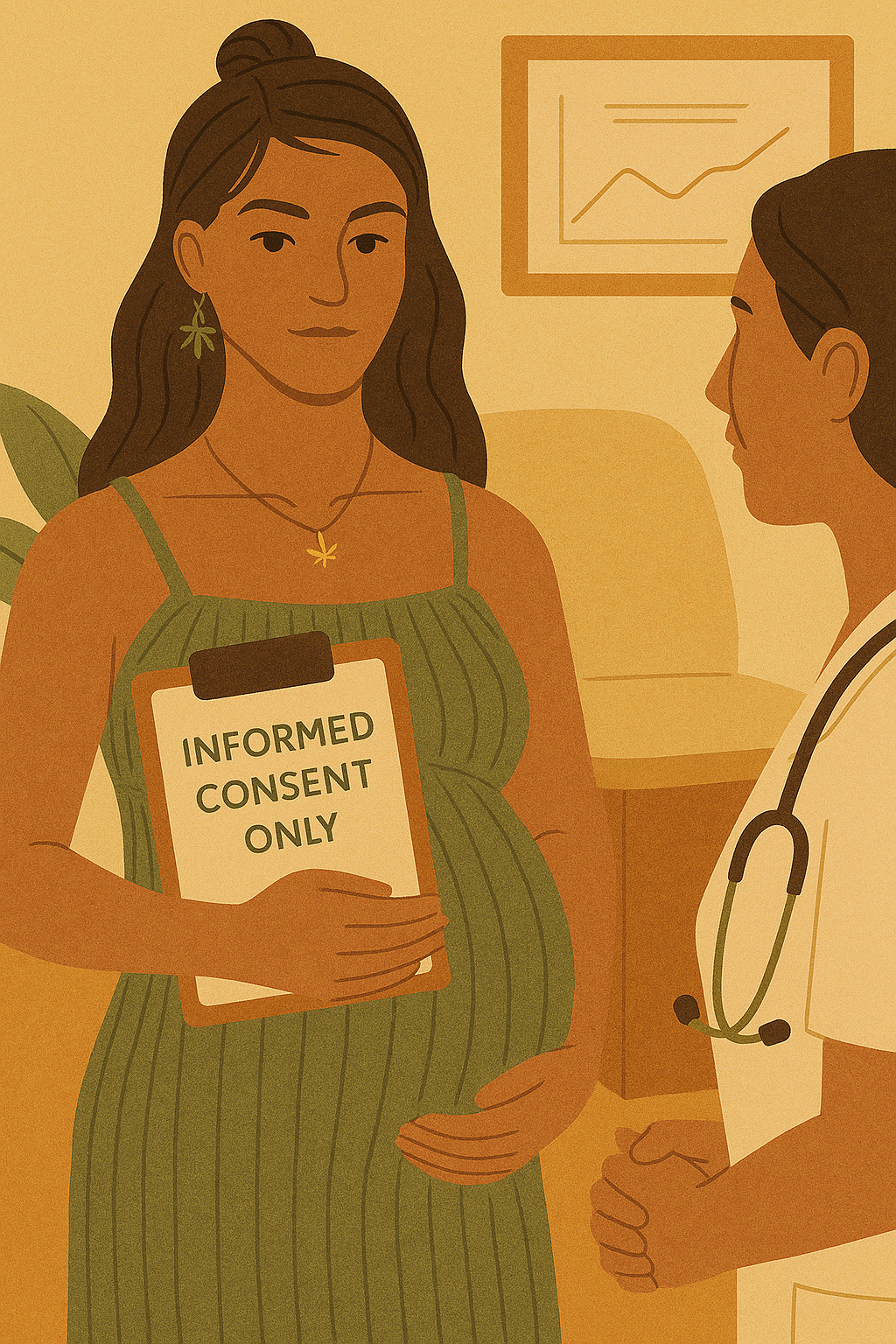
Your healthcare decisions deserve informed consent, not fear, stigma, or pressure.
Before sharing sensitive personal information with a healthcare provider, you deserve to understand how that Before You Disclose: Questions Every Mother Should Ask About Cannabis, Medical Privacy & Hospital Reporting
Information may be documented, who may have access to it, whether testing is routinely performed, and under what circumstances information may be shared with outside agencies.
This is particularly important for mothers navigating cannabis use during pregnancy or breastfeeding. Between inconsistent provider education, varying hospital policies, and the stigma surrounding cannabis, many mothers find themselves navigating healthcare conversations without knowing what questions to ask or what consequences certain disclosures may carry.
And let's be honest: not every healthcare provider has extensive education about cannabis, its potential therapeutic applications, or the current research surrounding its use during pregnancy and breastfeeding.
Some providers are compassionate, informed, and willing to have nuanced conversations. Others may approach the subject with personal biases, outdated assumptions, or an unwillingness to discuss anything beyond immediate discontinuation.
You deserve to know what kind of provider you're working with BEFORE you find yourself in a vulnerable position.
This guide is designed to help mothers understand what to ask, what to look for, and when it may be time to consider finding a provider whose approach better aligns with their healthcare needs.
This is not about encouraging patients to lie to their providers, withhold medically necessary information, or disregard clinical recommendations. It's about understanding patient privacy, informed consent, and the policies that may affect your care before making decisions about sensitive disclosures.
Because asking questions is not an admission. Wanting to understand your rights is not suspicious. And advocating for yourself does not make you a difficult patient.
You deserve to be an informed participant in your own healthcare.
1. start with your provider's education, experience & potential bias
Before discussing testing or reporting policies, it's worth understanding whether your provider is equipped to have an informed conversation about cannabis in the first place.
Cannabis education is not necessarily a standard or comprehensive component of every healthcare professional's training. A provider may have extensive experience in obstetrics, family medicine, or pediatrics without having specialized education in cannabinoid pharmacology, cannabis research, or therapeutic applications.
A lack of specialized education doesn't automatically make someone a bad provider. What matters is whether they're willing to acknowledge what they don't know, explore available evidence, and provide compassionate care without allowing personal beliefs to interfere with their professional responsibilities.
Questions to ask:
🌿 What education or training have you received regarding cannabis and its potential therapeutic applications?
🌿 How familiar are you with current research regarding cannabis use during pregnancy and breastfeeding?
🌿 Do you have experience caring for patients who use cannabis for medical or therapeutic reasons?
🌿 How do you approach patients who choose cannabis as an alternative to, or in addition to, conventional pharmaceuticals?
🌿 Are you comfortable discussing potential benefits, risks, uncertainties, and alternatives without judgment?
🌿 If your personal beliefs differ from a patient's treatment preferences, how do you ensure those beliefs don't interfere with the quality of care you provide?
🌿 Are you willing to consult additional resources or collaborate with another qualified provider when a patient's circumstances fall outside your area of expertise?
One particularly revealing question:
"Can you explain how you distinguish your personal opinions about cannabis from your professional responsibilities when caring for patients who use it?"
Pay attention not only to the answer, but also to how the question is received.
A provider who is willing to have an honest conversation, acknowledge limitations, and explain their clinical reasoning is generally going to be a much better partner in your care than someone who responds with judgment or intimidation.
You don't need a provider who agrees with every decision you make. You need one who respects your autonomy and is willing to provide appropriate care.
2. understand the practice's drug testing policies
Before assuming that a toxicology screen is standard, necessary, or inevitable, ask what your provider's actual testing policies are.
Drug testing practices can vary between individual providers, healthcare systems, hospitals, and states. Some facilities may conduct routine screenings under certain circumstances, while others may order testing based on clinical indications or specific concerns.
Understanding these policies ahead of time can help you make informed decisions about your care and avoid being caught off guard.
Questions to ask:
🌿 Does your practice routinely perform drug screenings during pregnancy or postpartum care?
🌿 Under what circumstances would a drug screening be ordered?
🌿 Are screenings universal, based on clinical indications, or dependent on individual circumstances?
🌿 What factors would prompt a provider to recommend or order a toxicology screen?
🌿 What is the process for obtaining patient consent before testing?
🌿 Can a patient decline a screening? If so, what are the potential clinical or administrative consequences?
🌿 Are patients informed before a toxicology screen is performed?
🌿 Are there circumstances in which testing may be performed without the patient's prior knowledge or consent?
Why this matters:
A routine prenatal laboratory panel and a toxicology screen are not necessarily the same thing.
Patients should understand what they're consenting to, what testing is being performed, and why it's considered clinically appropriate.
You also deserve to know whether a test is being ordered for a specific medical reason, as part of a facility-wide policy, or because of another concern.
If your provider cannot clearly explain their testing practices, consider contacting the practice's patient advocate, compliance department, or intended delivery hospital for clarification.
3. find out exactly what is being tested and why
Not all drug tests are created equal.
Different testing methods detect different substances, compounds, and metabolites. They may also have different detection windows, limitations, and implications for interpreting results.
For example, a screening result involving a cannabis metabolite does not automatically establish current impairment, the precise timing of use, frequency of use, or the amount of THC present in someone's body.
A positive initial screening result may also require confirmatory testing before it can be interpreted as a definitive finding.
Questions to ask:
🌿 What specific substances or compounds are included in the screening?
🌿 Does the screening include THC or cannabis metabolites?
🌿 What specimen is being collected: urine, blood, hair, meconium, umbilical cord tissue, or something else?
🌿 Is this an initial screening test or a confirmatory laboratory test?
🌿 What is the clinical purpose of the testing?
🌿 How are the results interpreted?
🌿 What are the limitations of the particular testing method?
🌿 How will the results be documented in my medical record?
🌿 Who will have access to the results?
🌿 Under what circumstances could the results be shared with other providers, hospitals, insurers, or outside agencies?
Remember: A laboratory result is not a complete medical history.
The particular compound being measured, the testing method, the specimen, and the circumstances surrounding the test all matter.
A screening result should not automatically be treated as proof of impairment, neglect, or an inability to safely care for a child.
Patients deserve accurate interpretation, appropriate follow-up, and the opportunity to understand what their results actually mean.
4. understand hospital policies and child welfare reporting procedures
This is one of the most important conversations to have BEFORE delivery.
A mother's experience with prenatal care may be very different from her experience once she enters a hospital for labor and delivery.
Hospitals may have their own testing protocols, documentation procedures, and reporting policies. The healthcare professionals involved in delivery may also have different responsibilities from the provider who has been overseeing prenatal care.
And here's something mothers need to understand:
A positive toxicology result, a hospital policy violation, and a mandatory child welfare report are three different things.
They should not automatically be treated as interchangeable.
Reporting requirements vary by state, and the circumstances that trigger a report may depend on applicable law, the facts of the situation, and the policies of the healthcare facility.
Do not assume that a medical cannabis recommendation, medical card, provider approval, or legal state status automatically prevents a report.
Likewise, do not assume that every positive screening result automatically requires one.
You deserve to understand the distinction.
Questions to ask your provider or intended delivery hospital:
🌿 Under what circumstances does your facility make a report to child welfare?
🌿 What specific circumstances or findings trigger a report?
🌿 Does a positive toxicology result automatically result in a report, or is additional assessment required?
🌿 How does your facility distinguish documented medical treatment from concerns involving impairment or infant safety?
🌿 Are reports based on state law, hospital policy, or both?
🌿 At what point during pregnancy, delivery, or postpartum care might a report be initiated?
🌿 Are patients informed when a report is being made, when legally permissible?
🌿 What information is shared with child welfare?
🌿 Is there an internal review process before a report is submitted?
🌿 Where can patients obtain a copy of the facility's written reporting policy?
One particularly important question:
"Can you explain the difference between a mandatory report under state law and an internal hospital policy regarding substance exposure?"
This distinction matters because a hospital's internal policies and an individual's legal reporting obligations are not necessarily identical.
You may also want to ask whether the facility has written policies addressing substance exposure during pregnancy and newborn care.
If you're uncomfortable asking these questions during an appointment, you can contact the hospital's patient advocate, social work department, compliance office, or patient relations department.
You can ask for general policy information without immediately volunteering personal information about your own circumstances.
5. discuss treatment planning and medical alternatives
For mothers using cannabis to manage a medical condition, simply being told to stop may not address the underlying medical need.
What happens when cannabis has been used to manage a debilitating condition? What happens when conventional medications have been ineffective, poorly tolerated, or incompatible with a patient's treatment goals?
A patient deserves an actual treatment conversation, not a dismissal.
This is particularly important for mothers navigating conditions such as Hyperemesis Gravidarum (HG), chronic pain, severe nausea, or other conditions that may significantly affect their ability to function, eat, sleep, or maintain adequate nutrition.
The potential risks of a treatment should be considered alongside the consequences of untreated illness and the potential risks and benefits of available alternatives.
Questions to ask:
🌿 If a patient is currently using cannabis to manage a medical condition, what treatment alternatives would you recommend?
🌿 How do you evaluate the potential risks of untreated illness compared with the potential risks of available treatment options?
🌿 What guidance can you offer beyond simply recommending discontinuation?
🌿 Are you familiar with medications commonly prescribed for this condition and their potential risks during pregnancy or breastfeeding?
🌿 Can you help coordinate care with a specialist familiar with my condition?
🌿 What documentation would you recommend maintaining regarding my diagnosis, treatment history, and medical needs?
🌿 How do you document a patient's informed treatment decisions when their circumstances involve a potentially controversial medication or substance?
🌿 If I choose a treatment option you do not personally recommend, will I continue receiving the same quality of care?
You deserve more than "just quit."
If a provider recommends discontinuing a treatment, they should be prepared to discuss the reasoning behind that recommendation, available alternatives, and how your underlying medical condition will be managed.
No treatment decision should be reduced to a judgment about whether a mother is making the choices someone else would make.
6. understand medical privacy, confidentiality & your records
Before sharing sensitive medical information, it's reasonable to ask how that information will be handled.
Many patients assume that everything shared with a healthcare provider remains completely confidential. While healthcare privacy laws provide important protections, confidentiality is not absolute.
For example, HIPAA permits certain disclosures and requires others under specific circumstances. State laws may also establish additional privacy protections or reporting obligations.
This means you should understand the limits of confidentiality rather than assuming that every disclosure will remain exclusively between you and your provider.
Questions to ask:
🌿 What are your confidentiality policies regarding substance use disclosures?
🌿 Under what circumstances can information shared during an appointment be disclosed outside my immediate healthcare team?
🌿 Are there exceptions to confidentiality involving pregnancy, newborn care, or child welfare?
🌿 Who can access my medical records?
🌿 Are laboratory results automatically shared with the hospital where I plan to deliver?
🌿 What information is included in my medical records?
🌿 How can I obtain copies of my records and laboratory results?
🌿 Can you explain the limits of patient confidentiality before I share sensitive medical information?
You may also want to familiarize yourself with your rights regarding access to your medical records and the process for requesting amendments when information is inaccurate.
Privacy matters. But understanding its limitations matters just as much.
7. know when it may be time to find another provider
Not every provider will have extensive cannabis education. That alone doesn't necessarily mean they're incapable of providing good care.
What matters is how they respond when a patient asks questions, expresses concerns, and needs help navigating a complicated medical decision.
A provider doesn't have to personally agree with every treatment decision to provide respectful, evidence-informed care.
However, if a provider repeatedly demonstrates that their personal beliefs are interfering with their ability to offer appropriate care, it may be time to consider other options.
potential red flags
Consider reconsidering your provider if they:
🚩 Refuse to discuss your treatment concerns or dismiss your medical history.
🚩 Rely on personal opinions, stigma, or assumptions instead of discussing available evidence.
🚩 Cannot explain their testing or reporting policies.
🚩 Threaten patients with child welfare involvement without explaining the applicable policies or legal requirements.
🚩 Refuse to discuss treatment alternatives or the potential consequences of untreated illness.
🚩 Make you feel unsafe asking questions or seeking clarification.
🚩 Suggest withholding care, abandoning treatment, or accepting inadequate care because of your treatment preferences.
🚩 Refuse to acknowledge the limits of their own education or expertise.
🚩 Treat a patient's cannabis use as an automatic indication of poor parenting or neglect without considering the individual circumstances.
green flags worth looking for
A supportive provider will ideally:
💚 Acknowledge the limits of their own education and experience.
💚 Be willing to review current research and evidence.
💚 Discuss potential risks, benefits, uncertainties, and alternatives without shaming patients.
💚 Clearly explain testing, confidentiality, and reporting policies.
💚 Respect patient autonomy while maintaining appropriate clinical safety standards.
💚 Help coordinate care when a patient's medical needs fall outside their expertise.
💚 Continue providing appropriate care even when they disagree with a patient's treatment preferences.
You deserve a healthcare provider who sees you as a patient, not a problem to be managed.
If you decide to change providers, consider doing so before delivery whenever possible. Ask about transferring records, coordinating ongoing treatment, and maintaining continuity of care.
And if you're already receiving care from a provider you don't trust, remember that you can seek a second opinion or contact patient relations to discuss your concerns.
8. you can ask questions without immediately disclosing personal use
This is worth emphasizing.
A patient can ask general questions about practice policies, routine testing, confidentiality, and reporting procedures without immediately volunteering personal information about their own cannabis use.
For example, you might say:
"I'm trying to better understand your practice's prenatal screening and confidentiality policies. Could you explain how those work?"
Or:
"I'm reviewing different delivery hospitals and want to understand their policies regarding toxicology screening and child welfare reporting. Where can I find that information?"
These are reasonable questions.
You do not need to begin a conversation by explaining your entire medical history just to understand how a healthcare facility operates.
Asking about a policy is not an admission.
You are allowed to seek information, understand your options, and evaluate whether a provider or facility is the right fit for your needs.
However, it's important to distinguish between asking general policy questions and withholding medically relevant information when it is needed for safe treatment.
9. when disclosure becomes important for medical safety
Patient autonomy and medical safety should work together.
Although patients should understand their privacy rights and the policies surrounding sensitive disclosures, there are circumstances where communicating cannabis use to the clinicians directly responsible for treatment is particularly important.
This includes situations involving:
⚠️ Surgery or procedures requiring anesthesia.
⚠️ Sedation or other medications that may interact with cannabis.
⚠️ Emergency treatment.
⚠️ Changes in medications or treatment plans.
⚠️ Symptoms or complications that may be affected by cannabis use.
⚠️ Other circumstances where substance use may influence clinical decisions.
Cannabis can interact with medications and may be relevant to anesthesia planning, cardiovascular considerations, sedation, and other aspects of clinical care.
If you're undergoing a procedure, tell the anesthesia and surgical teams about your cannabis use, including the products, route, frequency, and timing when relevant. Follow their instructions regarding use before the procedure.
If you're unsure whether something is medically relevant, ask.
Your provider cannot make fully informed clinical decisions without information that may materially affect your safety.
The goal isn't to avoid necessary medical conversations. It's to make sure those conversations happen with providers who can approach them professionally, respectfully, and without unnecessary judgment.
10. know the difference between a medical recommendation, a facility policy, and a legal requirement
These three things are often confused, but they are not interchangeable.
A medical recommendation: A provider may recommend discontinuing cannabis or pursuing another treatment based on their clinical assessment, available evidence, and professional judgment.
A facility policy: A hospital or healthcare system may have internal procedures regarding testing, documentation, patient care, and reporting.
A legal requirement: Federal or state law may impose specific obligations on healthcare professionals or facilities under certain circumstances.
A provider recommending that you stop using cannabis does not automatically mean you are legally required to do so.
Likewise, a hospital having a particular policy does not necessarily mean every aspect of that policy is mandated by state law.
And a provider's approval of a treatment does not automatically exempt a patient or facility from applicable reporting requirements.
If you are unsure how a policy or law applies to your circumstances, consider consulting a qualified attorney familiar with healthcare law and the laws in your state.
Do not rely solely on social media posts, another mother's experience, or a provider's verbal assurances when making decisions about legal exposure.
Want to take these questions into your next appointment?
I've created a FREE Patient Advocacy Worksheet to help you prepare for conversations with your healthcare provider and intended delivery hospital.
It includes the questions covered in this article, space to record provider responses, and a place to document important policies, contact information, and follow-up questions.
You don't have to memorize everything or navigate these conversations unprepared.
Download your FREE Patient Advocacy Worksheet and take an active role in your healthcare. 💗
a final word to mothers navigating cannabis-related healthcare stigma
You should not have to choose between receiving compassionate medical care and feeling safe enough to have an honest conversation with your healthcare provider.
You should not have to defend your character, your parenting, or your medical history simply because your treatment preferences fall outside someone else's personal beliefs.
And you should never feel that asking questions makes you suspicious, irresponsible, or undeserving of care.
Your body, your medical needs, and your healthcare decisions deserve to be treated with respect.
Understanding your provider's education, testing policies, confidentiality practices, and reporting procedures can help you make more informed decisions about your healthcare relationships and how you navigate sensitive conversations.
Remember:
You can ask questions before volunteering sensitive personal information.
You can request clarification about testing and reporting policies.
You can seek a second opinion.
You can advocate for alternative treatment options.
You can look for a provider who approaches your care with compassion and evidence-informed guidance.
And when medically relevant information is needed to protect your safety, you deserve to be able to share it with a healthcare professional who will treat you with dignity.
Fear is not informed consent. Stigma is not education. And judgment is not healthcare.
You deserve better.
💗 END THE STIGMA.💗
important disclaimer
This article is intended for educational and informational purposes only. It is not legal advice, medical advice, or a substitute for individualized guidance from qualified professionals.
Healthcare privacy protections, consent requirements, toxicology screening practices, and child welfare reporting obligations vary by state, jurisdiction, and individual circumstances. No medical cannabis recommendation, medical card, provider approval, or documentation guarantees exemption from testing or reporting.
Patients should consult qualified healthcare professionals regarding medically relevant disclosures and treatment decisions. For questions about legal rights, reporting requirements, or potential legal consequences, consult an attorney familiar with the laws in your jurisdiction.
Explore more: Visit The Stoned At Home Mom's resource library for educational materials, research, study collections, and state-specific resources to help mothers navigate cannabis-related pregnancy and breastfeeding stigma.